
5 Discussion Hammers: What role does audiovisual technology play in the quality of a meeting and event venue?
Good audiovisual technology supports the quality of a meeting or event venue without unnecessarily drawing attention to itself. Visual content needs to be clear, speech intelligible and controls straightforward. At the same time, venues increasingly need to accommodate different types of meetings and events. What role does AV play in creating a professional and flexible venue?
What role does audiovisual technology play in the quality of a meeting and event venue?
A high-quality meeting or event venue involves much more than an attractive room. A space also needs to work in practice. Presentations need to be visible, speakers need to be intelligible and the technical environment needs to support the type of meeting being organised.
Audiovisual technology is therefore part of the overall quality of Hotels & event venues.
Facilities are also one of the areas considered by YOIN excellent meeting places, the successor to the former Vergaderhamers classification. The current quality label additionally considers service, hygiene, communication and maintenance. AV should therefore not be presented as the complete quality framework, but as part of a wider professional venue environment.
Why is AV important for a professional meeting venue?
Audiovisual technology is ultimately not about the equipment itself. Its purpose is to support communication.
During a meeting or conference, information needs to be communicated clearly. Participants need to see presentations and hear speakers. When remote participants join a meeting, the digital connection becomes part of that same experience.
Technology that does not work properly can immediately disrupt a meeting. Poor speech intelligibility, presentation content that cannot be seen clearly or unnecessarily complicated controls distract from the actual programme.
Well-integrated AV does the opposite. It supports the meeting without requiring constant attention.
Four principles are therefore particularly relevant within professional venues:
- Speech intelligibility
- Visibility
- Ease of use
- Reliability
For multifunctional event venues, a fifth consideration becomes equally important: flexibility.
Speech intelligibility provides the foundation
Speech is the main form of communication during many business meetings. A presentation can be visually strong, but information will still be lost when speakers or participants are difficult to understand.
The appropriate audio environment depends on how a room is used. A smaller boardroom requires a different approach from a large conference hall with a stage and multiple speakers.
For formal meetings, a professional Meeting system can help structure discussion while supporting clear speech for participants.
Conferences and events may require a wider combination of microphones, loudspeakers, technical operation and coordination with the programme.
The underlying principle remains the same: participants should be able to concentrate on the content rather than the technology.
Visual technology needs to match both the room and its purpose
Visibility is another important part of the meeting experience.
Presentations, video content, remote participants, agenda information and camera feeds need to be clearly visible from the relevant positions in the room. There is no single display solution that is appropriate for every venue.
Boardrooms, conference spaces and large event halls differ in size, sightlines and intended use.
A suitable audiovisual environment therefore starts with questions such as:
- What is the room used for?
- How many participants usually attend?
- What information needs to be displayed?
- From which positions should that content be visible?
- Does the room configuration change regularly?
Video, audio and control can then be designed as one integrated environment.
Ease of use is part of the service experience
Hotels and event venues are used by a wide variety of people.
Unlike an office in which employees may use the same meeting room every day, a hotel or conference venue continuously welcomes new organisers, speakers and guests.
Ease of use therefore becomes particularly important.
A room with extensive technical functionality is not automatically a better room. If technical assistance is required for every straightforward meeting, complexity can become a disadvantage in everyday operation.
For recurring meetings, logical and consistent controls can reduce the number of technical steps required. Larger events, on the other hand, may benefit from dedicated professional technical support.
The aim is therefore not to install as much technology as possible, but to create an AV environment that matches the way the venue operates.
Fixed boardrooms benefit from simple and familiar technology
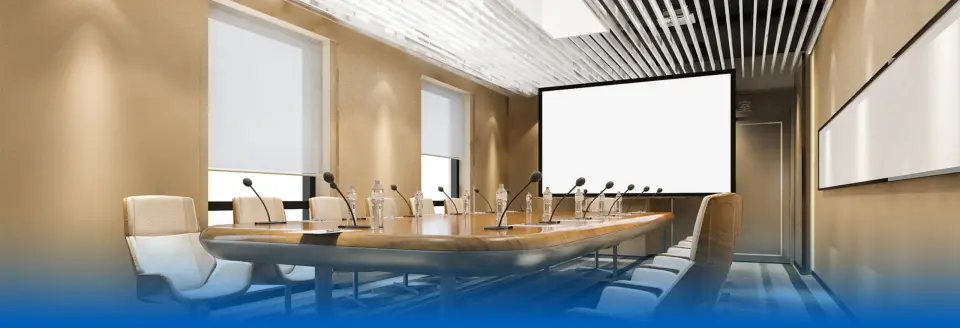
In addition to flexible event spaces, many hotels provide boardrooms and other meeting rooms with a fixed layout. In these environments, it is particularly important that changing guests can use the available technology quickly and without extensive instructions.
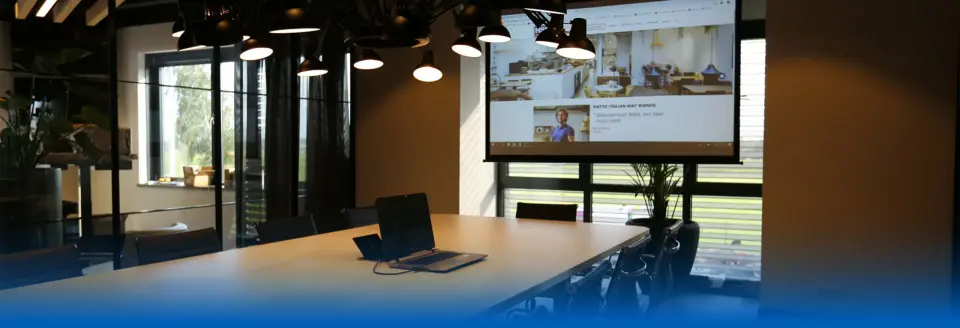
One suitable approach is Bring Your Own Device (BYOD). Guests use their own laptop and familiar meeting platform, such as Microsoft Teams, Zoom or Google Meet. The laptop connects to the audiovisual facilities in the room, allowing the fixed camera, microphones, loudspeakers and display to be used.
A videobar can combine several of these functions in one permanent solution. With a straightforward plug-and-play connection, users do not first need to learn how to operate a separate conferencing platform provided by the hotel.
With a suitable USB-C configuration, a single cable can, for example, handle video, audio and USB functionality while also charging the laptop. This depends on the equipment and laptop being used, but can significantly reduce the number of steps required for guests.
For hotels, this approach offers a practical advantage. Guests continue working from their own laptop, calendar and familiar meeting platform while benefiting from the professional AV facilities available in the room.
Heuvelman has also applied this BYOD principle within the meeting environment at Sheraton Amsterdam Airport Schiphol, where ease of use for changing users was an important consideration.
A fixed boardroom therefore mainly benefits from predictability and simple operation. In a multifunctional venue, the challenge is different: the technology needs to adapt to changing room configurations and programmes.
Flexible spaces require flexible audiovisual technology
Many hotels and event venues use the same space for different types of meetings. A room may host a plenary presentation in the morning and later be divided into several smaller breakout sessions.
This creates different technical requirements from a room with one permanent purpose.
A practical example is Apex at the Leonardo Royal Hotel Amsterdam. Heuvelman provided the audiovisual support for a plenary space including video, audio and camera production. Between programme elements, the same hall could be transformed into three separate breakout rooms, each with independent technical support.
This illustrates why flexibility extends beyond moving walls or furniture. The audiovisual environment also needs to adapt to the changing role of the space.
More information is available in the Apex at Leonardo Royal Hotel Amsterdam case.
Permanent AV and temporary event technology can complement each other
Not every meeting requires the same technical scale.
Meeting rooms can have a permanent audiovisual foundation for everyday use, supporting applications such as presentations, audio, video conferencing and room control.
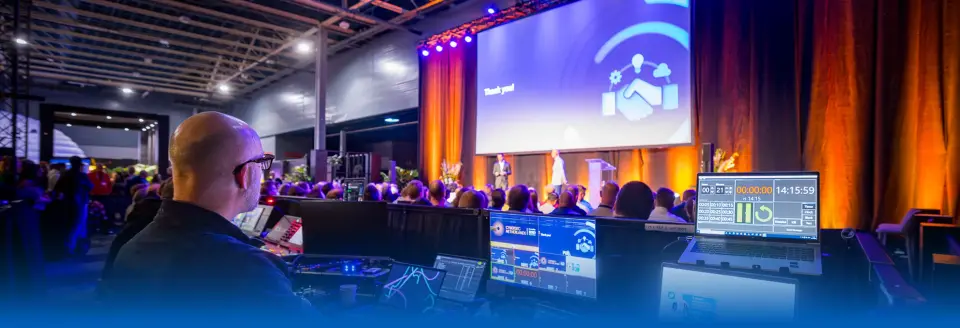
Larger conferences, product presentations, gala events or other productions may require additional temporary event technology. This enables a venue to adapt to a specific event without permanently installing every piece of equipment that might occasionally be required.
For Hotels & event venues, the combination can provide a practical model: reliable permanent technology for daily operation with the ability to expand for larger productions.
Heuvelman's work with Jaarbeurs provides an example in which permanent audiovisual facilities are combined with technical support for events. The existing case covers video, audio and digital signage applications across conferences, exhibitions and other events.
AV can contribute beyond the meeting room
The audiovisual experience of an event venue does not necessarily begin at the entrance to the meeting room.
Larger conference and event venues also need to provide information throughout the building. Visitors may need to find a programme session, identify the correct room or see where their next meeting takes place.
Digital signage and room-booking systems can support that visitor journey.
At MECC Maastricht, for example, Heuvelman manages a digital signage environment used for wayfinding and current event information. In addition, 55 meeting and breakout rooms are equipped with room-booking displays showing reservations and occupancy information.
This demonstrates that AV within a professional event venue extends beyond displaying a presentation. Technology can also support information provision and the efficient use of the venue as a whole.
Reliability matters when spaces form part of a commercial service
A meeting room within a hotel or event venue forms part of the organisation's service offering. When a room has been booked, it needs to be available for the intended purpose.
Reliability is therefore an important consideration within the technical environment.
This involves more than the quality of individual devices. System integration, controls, management and support all affect how predictably the AV environment performs in everyday operation.
Professional venues therefore benefit from considering the complete user environment rather than purchasing audiovisual components in isolation. Everything from starting a presentation to supporting a complex conference needs to work as part of the wider service.
From 5 Vergaderhamers to the modern event venue
The frameworks used to assess venue quality have changed over time.
The former Vergaderhamers made quality visible through a classification system in which five hammers represented the highest level.
Since 2021, the quality label has continued as YOIN excellent meeting places. Its current assessment covers areas including facilities, service, hygiene, communication and maintenance.
The name and assessment approach have changed, but the underlying question remains relevant: what does a professional venue need in order to support meetings and events consistently at a high level?
Audiovisual technology is one part of that answer. Not as an isolated collection of equipment, but as part of the space, the service and the experience provided to organisers and participants.
AV advice for hotels and event venues
A professional AV environment starts with the purpose of the room and the way it is used in everyday operation. For hotels, conference centres and event venues, this often requires a balance between ease of use, quality, reliability and flexibility.
Heuvelman supports Hotels & event venues with permanent and temporary audiovisual solutions for meeting rooms, conference spaces and events.
For advice on an audiovisual environment suited to the venue and its applications, organisations can contact Heuvelman or schedule an advisory conversation.

View other references



Let's get in touch
Want to know how we can take your business to the next level? Then get in touch!
Heuvelman stands for:
- Innovative tailor-made audiovisual total solutions
- Reliable and sustainable services
- Experienced and skilled team with a focus on high quality
- Personal support from start to finish
- Flexible in planning and execution
- ISO 27001 certified for rental and sales projects