
How many cameras and microphones do you need for a conference?
A presentation with one speaker requires a different technical setup from a conference with panel discussions, interviews, Q&A and online participants. The starting point is therefore not equipment quantities, but what needs to be seen and heard throughout the programme.
How many cameras and microphones do you need for a conference?
There is no standard answer such as three cameras and four microphones. Two conferences with the same number of attendees can have completely different technical requirements.
For Events & Congresses, we therefore start by looking at the programme, room, stage and the way participants will interact. Only then does it become clear how many camera and audio positions are required.
Start with the programme, not the audience size
The programme largely determines the technical requirements.
A conference may include:
- Individual presentations
- Panel discussions
- Stage interviews
- Audience Q&A
- Several programme formats throughout the day
- Breakout sessions
- A livestream or recording
The more situations the programme includes, the more important it becomes to determine in advance who needs to be visible and audible at each moment.
How many cameras are required?
The main question is not simply how many cameras are available, but which shots are required.
A simple recording may focus mainly on the speaker. A more extensive programme may also require wide shots, panel coverage, interviews and reactions from the audience.
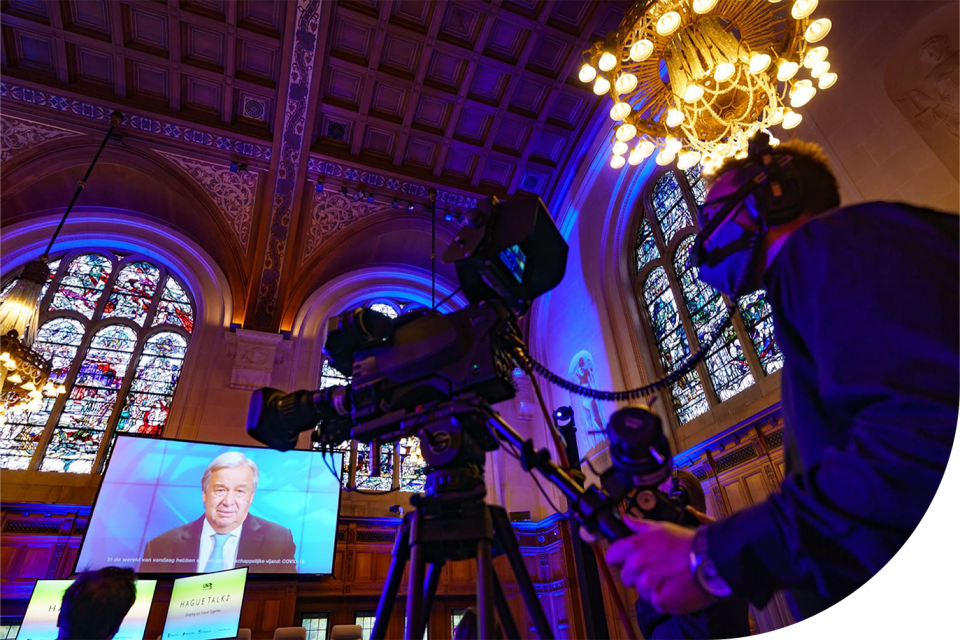
For a livestream, camera recording also becomes part of the overall directing process. Shot selection, switching and timing need to follow the speakers and the programme. This is also part of our Studio & Livestreaming expertise.
More cameras are therefore not automatically better. The aim is to have the right coverage for the programme.
How many microphones are required?
The same principle applies to microphones.
The starting point is who needs to speak during the programme. This may include:
- Hosts
- Individual speakers
- Panel members
- Interviewers and guests
- Audience members asking questions
A panel with several participants needs a different audio setup from a single presenter remaining on stage throughout a session.
The way microphones are used also matters. A fixed lectern position has different requirements from speakers moving around the stage or taking part in a discussion.
Speech intelligibility remains the priority. For livestreaming and hybrid events, microphones, mixing and monitoring form an important foundation of the production.
Audience interaction changes the setup
Interaction from the room is an important consideration that can easily be underestimated.
If attendees are expected to ask questions, the production needs a clear way to make those questions audible. For a livestream, online viewers also need to hear both the question and the response.
This means the audio plan should cover more than the stage alone. The room itself and the way Q&A is organised also need to be considered.
The same applies to camera coverage. If audience interaction is an important part of the programme, those moments may also need to be captured visually.
Livestreaming creates different requirements
Once a conference is also followed online or needs to be available afterwards, the technical requirements change.
A speaker may be clearly visible to people sitting in the room. An online participant, however, relies entirely on cameras, audio and directing.
Within Studio & Livestreaming, we therefore consider camera recording, audio, connectivity, presentation flow and directing as one production chain.
Camera and microphone choices should therefore never be made in isolation.
What information is needed in advance?
The following questions help determine a suitable setup:
- What does the programme look like?
- How many speakers will be on stage at the same time?
- Are there panel discussions or interviews?
- Will the audience participate?
- What are the dimensions and layout of the room?
- Are there breakout sessions?
- Will the conference be recorded or streamed live?
- Which shots do online participants need to see?
These answers allow the technical setup to follow the actual programme rather than a standard equipment package.
How we determine the AV setup for a conference
We consider cameras and microphones as part of the complete production.
The programme, stage, room layout, interaction, video recording and audio all need to work together. A relatively simple setup may therefore be sufficient for one conference, while another requires several camera positions and different microphone solutions.
The objective is not to use as much technology as possible, but to make the technology fit the programme.
Advice on AV for conferences
The right number of cameras and microphones follows from the programme, venue and desired experience for both on-site and online participants.
Contact us to discuss the audiovisual setup for a conference or to schedule an advisory conversation.

View other references


Let's get in touch
Want to know how we can take your business to the next level? Then get in touch!
Heuvelman stands for:
- Innovative tailor-made audiovisual total solutions
- Reliable and sustainable services
- Experienced and skilled team with a focus on high quality
- Personal support from start to finish
- Flexible in planning and execution
- ISO 27001 certified for rental and sales projects