
5 tips for a successful corporate Christmas party
Whether a Christmas party takes place at the office, an event venue or another external location, audiovisual technology should match the programme. An informal reception requires a different approach from an evening with speeches, entertainment, a DJ or live band. Including technology early in the preparation creates more room to design the event as one coherent experience.
5 tips for a successful corporate Christmas party
A corporate Christmas party gives organisations an opportunity to close the year together. Employees meet outside their usual working environment, achievements can be recognised and there is time for informal interaction. The event may be a small reception at the office or a larger celebration at an external venue.
Atmosphere is not created by decoration, catering and entertainment alone. Audiovisual technology also plays an important role. A speech needs to be clearly understood throughout the room, music needs to suit the space and lighting can help give different parts of the evening their own character.
A strong technical setup therefore does not start with a list of equipment. We first look at the programme, venue, number of guests and desired atmosphere. Those factors determine how sound, lighting, visuals and technical support should be used.
These five points provide a practical starting point for organisations preparing a corporate Christmas party.
Tip 1 – Start with the programme, not the equipment
A common mistake in event preparation is to start by asking how many speakers, microphones or screens are required. Those numbers only become meaningful once the programme is clear.
An end-of-year reception with background music has different requirements from an evening centred around a stage programme. A short management speech also requires a different setup from an event combining awards, video, a DJ and live entertainment.
First define:
- The expected number of guests
- The different programme elements
- Whether speeches or presentations are planned
- Whether video or other visual content will be shown
- Whether a DJ, band or other entertainment is involved
- Whether multiple spaces will be used
- Whether the room layout changes during the evening
- How reception, dinner and party elements follow each other
This creates the basis for the technical setup.
We therefore recommend treating audiovisual technology as part of the programme rather than as a separate element added later.
Tip 2 – Make sure speeches and entertainment can be heard clearly
Audio is one of the first things guests notice when something is not working well.
A speech that cannot be understood at the back of the room, background music that makes conversation difficult or live entertainment that does not suit the space directly affects the experience.
Good audio therefore starts with the room and the programme.
Important questions include:
- How large is the space?
- How many guests will attend?
- Where will guests be standing or sitting?
- Are speeches delivered from one fixed position?
- Is there background music, a DJ or live band?
- Is the same room used for several programme elements?
- What are the acoustic characteristics of the space?
The setup of the audience also matters. Guests remain relatively fixed during dinner, while a reception or party involves continuous movement.
For speeches, intelligibility should be the main priority. For entertainment, music experience, distribution and the desired sound level also become important.
The right solution therefore starts with translating the space and programme into an appropriate audio setup rather than simply adding more equipment.
Tip 3 – Use lighting and visuals to support the atmosphere
Lighting strongly influences how a room feels. A standard meeting room, company hall or event space can look completely different when lighting is designed around the event.
Lighting can also help support different stages of the programme.
Examples include:
- Warm ambient lighting during reception and dinner
- Accent lighting around a stage
- Different lighting settings when the party begins
- Colours that match the corporate identity or event theme
- Lighting to support performers or entertainment
Visual content can also form part of the event.
Screens or other visual solutions can be used for:
- Welcome messages
- Corporate branding
- Photography from the past year
- An end-of-year video
- Presentations or speeches
- Visuals during entertainment
- Practical programme information
The key is that lighting and visuals should support the event. More technology does not automatically create a better atmosphere. The application should match the space, programme and overall character of the Christmas party.
Tip 4 – Align venue and technology early
A Christmas party may take place at a professional event venue, but it can also be organised in an office, company hall, restaurant or another space that is not normally used for events.
That difference matters technically.
A space that works well for daily business operations is not automatically suitable for an event involving music, presentations and entertainment.
During preparation, we therefore look at factors such as:
- Available power;
- Space for stage and technical equipment;
- Mounting possibilities;
- Sightlines towards stage and screens;
- Acoustics;
- Load-in and load-out possibilities;
- Accessibility;
- Existing technical facilities;
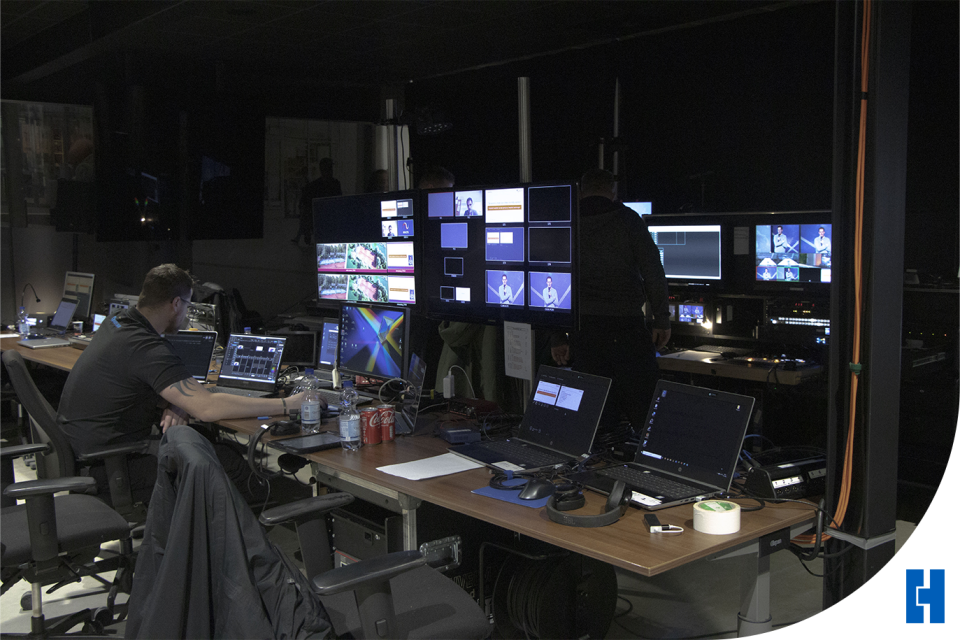
- Positions for control and technical support.
The same questions also matter at external event venues. Existing facilities may be available, but they still need to match the planned programme.
Within Events & Congresses, we therefore see technical preparation as part of the overall event planning.
The earlier venue, programme and technology are aligned, the less likely major changes become during the final preparation phase.
Tip 5 – Define technical responsibilities in advance
An event can be well prepared technically and still feel disorganised when responsibilities are unclear during the programme.
This becomes especially visible during transitions.
A speech begins, followed by a video. Entertainment then moves onto the stage and later a DJ takes over. Every transition requires coordination.
Define in advance:
- Who communicates with the organisation
- Who supports speakers
- Who manages microphones
- Who starts presentations and videos
- Who monitors technical cues
- Who communicates with DJs, bands or performers
- Who handles programme changes
- Who makes technical decisions during the event
A relatively simple Christmas party may only require limited technical support. A more extensive programme may require additional coordination.
The objective remains the same: technology should operate reliably in the background so attention stays on the guests and the programme.
Internal or external Christmas party: what changes technically?
An internal Christmas party at the organisation's own location often requires more preparation around the physical space. Offices, atriums, canteens and company halls are usually designed for everyday use rather than events.
This can affect sound, lighting, power, sightlines and technical setup.
An external event venue often already has technical facilities available. However, that does not automatically mean those facilities match the planned event. The programme may still require additional audio, visuals, lighting or technical support.
The same process therefore remains useful:
- Define the programme
- Assess the venue
- Identify which facilities are already available
- Align additional technology
- Define responsibilities and execution
This makes it clear which parts are already covered and where additional event technology is needed.
Common mistakes at corporate Christmas parties
Discussing technology too late
When the room layout, entertainment and programme have already been fully fixed, technical options may be limited. Early coordination creates more room to integrate technology properly.
Only planning for music
A Christmas party often includes more than a DJ or background music. Speeches, presentations, video, awards and entertainment all place different demands on the technical setup.
Underestimating the room
A large or attractive venue is not automatically suitable for clear audio or good sightlines. The practical characteristics of the space need to be assessed.
Not preparing programme transitions
Reception, dinner, speeches and party sections often require different settings. Without preparation, transitions can create unnecessary delays or confusion.
Not defining technical responsibility
If nobody is clearly responsible for visuals, sound and programme transitions, even small changes can become unnecessarily complicated.
Practical checklist for a corporate Christmas party
The following questions help start the technical preparation:
- What is the purpose and character of the Christmas party?
- How many guests are expected?
- Which programme elements are planned?
- Are there speeches, presentations or videos?
- Is there a DJ, live band or other entertainment?
- Which rooms or spaces will be used?
- Will the setup change during the evening?
- What role do visuals and lighting play?
- Which technical facilities are already available?
- Is enough time available for setup and preparation?
- Who manages the technical execution during the event?
- Have programme transitions been discussed in advance?
Not every Christmas party requires an extensive production. Answering these questions early does make it easier to determine which technology is actually needed.
How we approach technology for a corporate Christmas party
We do not start with individual pieces of equipment. We first look at the event as a whole. The programme, venue, number of guests and desired atmosphere determine which audiovisual support is appropriate.
In some cases, that means a relatively simple setup for background music and a short speech. In other situations, the programme may include lighting, visuals, entertainment and technical support.
Connecting these elements in advance allows technology to support the event without becoming the focus. It also makes execution more predictable and helps different parts of the evening flow naturally into one another.
Advice on technology for a corporate Christmas party
An internal or external Christmas party requires audiovisual technology that fits the venue, programme and desired atmosphere. Organisations that want to discuss the technical setup at an early stage can contact us to schedule an advisory conversation about the possibilities and starting points.

View other references







Let's get in touch
Want to know how we can take your business to the next level? Then get in touch!
Heuvelman stands for:
- Innovative tailor-made audiovisual total solutions
- Reliable and sustainable services
- Experienced and skilled team with a focus on high quality
- Personal support from start to finish
- Flexible in planning and execution
- ISO 27001 certified for rental and sales projects