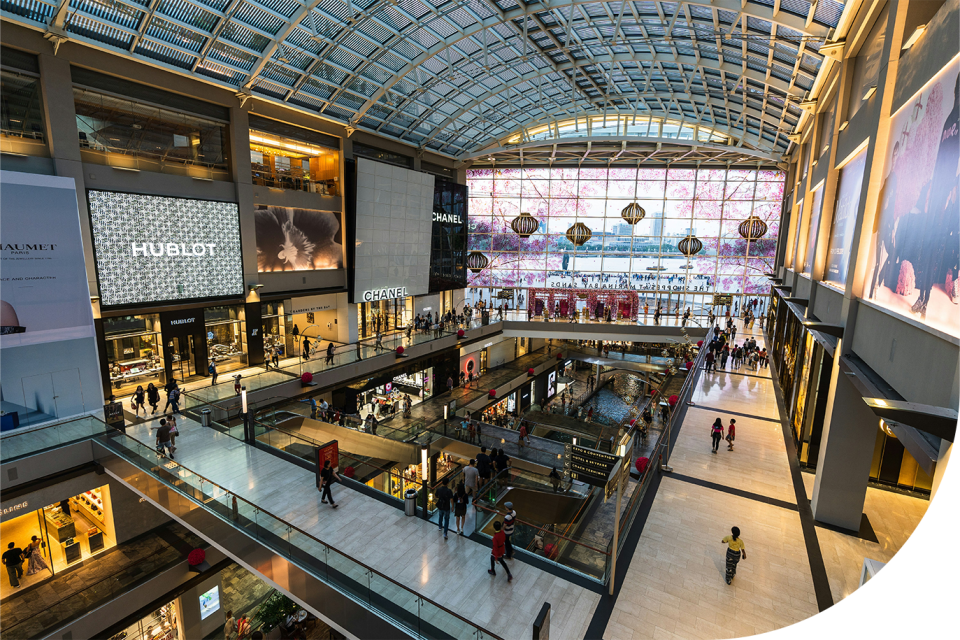


Digital signage in retail
A strong digital signage solution starts with the communication objective and the customer journey. Decisions about screens, placement, content management and technical setup follow from that foundation. For organisations with multiple locations, scalability, central management and daily operation should also be considered from the start.
Digital signage in retail: the complete decision guide
Digital signage is increasingly used in retail to inform customers, make campaigns visible and strengthen the in-store experience. But a strong solution does not start with choosing a screen. The most important questions come earlier: what do you want to communicate, where is the customer at that moment, who manages the content and how will the solution remain reliable?
For retailers, digital signage can add real value, but only when the technology fits the purpose, the location and the daily operation. A screen in the wrong place, outdated content or a system that is difficult to manage will not deliver the desired result. That is why we first look at the full context before making technical choices.
What is digital signage in retail?
Digital signage in retail means using digital screens to show information, campaigns or branded content in and around a retail environment. This can be inside the store, at the entrance, in the shop window, on a façade, in a shopping centre or at a temporary promotional location.
Examples include:
- Promotions and offers
- Product information
- Brand campaigns
- Wayfinding and visitor information
- Opening hours
- Queue communication
- Content for multiple store locations
- In-store retail media
- Digital shop window communication
- Outdoor screen communication
The main advantage is flexibility. Content can be updated faster than print and, depending on the system, managed centrally. This allows communication to move with campaigns, stock, seasons, opening hours and local circumstances.
Start with the purpose, not with the screen
A common mistake is to approach digital signage as a hardware choice. In practice, it starts with the communication objective.
Do you want to attract passers-by? Then visibility, brightness, placement and short messages are important. Do you want to inform customers inside the store? Then readability, routing and timing become more important. Do you want to manage several locations centrally? Then content management, user rights and standardisation are just as important as the screen itself.
Ask questions such as:
- What message needs to be visible?
- Who is the content meant for?
- Where is the customer at that moment?
- How much time does someone have to read the message?
- How often does the content change?
- Who manages the content?
- Should content be managed locally, centrally or both?
- Is the screen intended for indoor use, outdoor use or a shop window?
- Should the solution be temporary or permanent?
These questions determine which technical solution is suitable.
The location determines many technical requirements
In retail, the screen location makes a major difference. A display in a shopping street has different requirements than a screen behind the counter or a display in a showroom.
For outdoor or entrance placement, brightness, weather resistance, stability and visibility are important. In a shop window, daylight and reflections play a major role. Inside the store, it is often more about viewing distance, screen size, mounting, customer flow and content that fits the moment in the customer journey.
Shopping street or entrance
Here, the goal is often to attract attention. The message must be short, clear and immediately recognisable. Moving images can help, but too much information has the opposite effect. Passers-by usually only have a few seconds to see the message.
Shop window
A digital shop window can strengthen campaigns or product communication, but it must deal well with daylight and reflection. The content must also remain readable from a distance.
Inside the store
Inside the store, digital signage can support product information, inspiration, promotions or brand experience. Screens should be a logical part of the customer route and not feel disconnected from the environment.
Multiple store locations
For multiple locations, management becomes more important. Often, retailers want to combine central formats with local freedom. This can include national campaigns managed centrally, supplemented with local promotions or store-specific information.
Content determines the success of digital signage
A good screen does not make poor content stronger. Content is therefore a crucial part of any digital signage strategy.
Retail content needs to be understood quickly. Customers often look briefly and while moving. That means: a clear message, strong contrast, limited text and a recognisable visual style.
Good retail content takes into account:
- Screen format
- Viewing distance
- Lighting conditions
- Brand identity
- Campaign objective
- Timing
- Relevance
- Readability
- Motion and animation
- Frequency of updates
A digital screen offers more flexibility than print, but it also requires rhythm. Who manages the content? How often is it updated? Are there fixed templates? Who checks whether the right message is visible at the right location?
Without a clear content process, digital signage can quickly become outdated. Old promotions remain visible, content is not adapted to the store location or the flexibility of the system is not fully used.
Central management or local flexibility?
For retailers with multiple locations, this is an important choice. Fully centralised management creates brand consistency and control. Local flexibility allows stores to respond quickly to local promotions or circumstances.
In many cases, a combination works best. For example:
- Central brand templates
- National campaigns from head office
- Local input fields for stores
- User rights per role
- Scheduling per location
- Publication approval
- Fixed content blocks for opening hours, promotions or wayfinding
This keeps communication recognisable while still allowing locations to respond to their own situation.
Do not forget management and maintenance
Digital signage is not a one-time screen installation. It is a communication tool that needs to work every day. That is why management, support and maintenance should be considered in advance.
Important questions include:
- Who checks whether screens are online?
- Who resolves issues?
- How are updates carried out?
- Who manages user rights?
- How is content scheduled?
- What happens in case of network issues?
- How do you prevent screens from showing outdated content?
- How quickly should support be available?
In retail environments, reliability is important. A black screen, incorrect content or a poorly visible message directly affects the appearance of the location. Preventive management and clear agreements help keep the solution reliable.
Common mistakes in retail digital signage
Choosing hardware too quickly
Choosing a screen without a clear objective often leads to a solution that works technically, but adds little commercial value.
Using too much text
Retail communication must be readable quickly. Long texts are usually not suitable for screens in retail environments.
Forgetting the viewing distance
Content that is readable on a laptop screen does not automatically work on a display in a shopping street or shop window.
Not defining a content process
If no one is responsible for updates, the content quickly becomes outdated.
Not considering management across multiple locations
As the number of locations grows, management often becomes more complex. Think early about user rights, formats, planning and local variations.
Treating outdoor and indoor signage the same
Outdoor locations have different requirements for brightness, placement, protection and stability than indoor spaces.
When is digital signage interesting for retail?
Digital signage is especially useful when communication changes regularly, needs to be relevant at different moments or must be managed centrally.
Consider situations where you want to:
- Change campaigns regularly
- Reduce print and poster changes
- Manage multiple stores centrally
- Inform customers more effectively
- Make promotions visible faster
- Use the entrance or shopping street more actively
- Guide visitors
- Deploy retail media
- Strengthen the visual brand experience
When content hardly changes and one fixed message is enough, print can still be suitable. But as soon as speed, flexibility, visibility and management become important, digital signage offers more possibilities.
Practical checklist for retailers
Use this checklist before choosing a digital signage solution:
- What is the purpose of the screen communication?
- Where will the screen be placed or mounted?
- Is the environment indoor, outdoor or behind glass?
- How much time does the customer have to see the message?
- What content needs to be shown?
- How often does the content change?
- Who creates and manages the content?
- Is central management required?
- Are there multiple store locations?
- Should local content be possible?
- What are the requirements for brightness and readability?
- How is support organised?
- Who checks whether everything keeps working?
- How does the solution fit the brand identity?
How we look at digital signage in retail
For retail digital signage, we do not only look at the screen. We look at the full application: purpose, location, content, management, reliability and maintenance.
This prevents the technology from becoming disconnected from the retail environment. A good digital signage solution should fit the customer journey, the brand, the daily operation and the way content is managed. From one striking display to a scalable solution for multiple locations: the right choices in advance determine the result in practice.
Want to know more?
Would you like to explore which digital signage solution fits your store, showroom or retail organisation? View our retail solutions or contact us for advice.
View other references





Let's get in touch
Want to know how we can take your business to the next level? Then get in touch!
Heuvelman stands for:
- Innovative tailor-made audiovisual total solutions
- Reliable and sustainable services
- Experienced and skilled team with a focus on high quality
- Personal support from start to finish
- Flexible in planning and execution
- ISO 27001 certified for rental and sales projects